Peptide blend protocol
Wolverine Stack (20 mg)
Wolverine Stack 20mg dosage protocol. BPC-157 + TB-500 reconstitution, injection schedule, and syringe measurements.
- Peptides
- bpc-157 + tb-500
- Vial
- 20 mg
- Water
- 3 mL
- Concentration
- 6.67 mg/mL
Sponsored
At a Glance
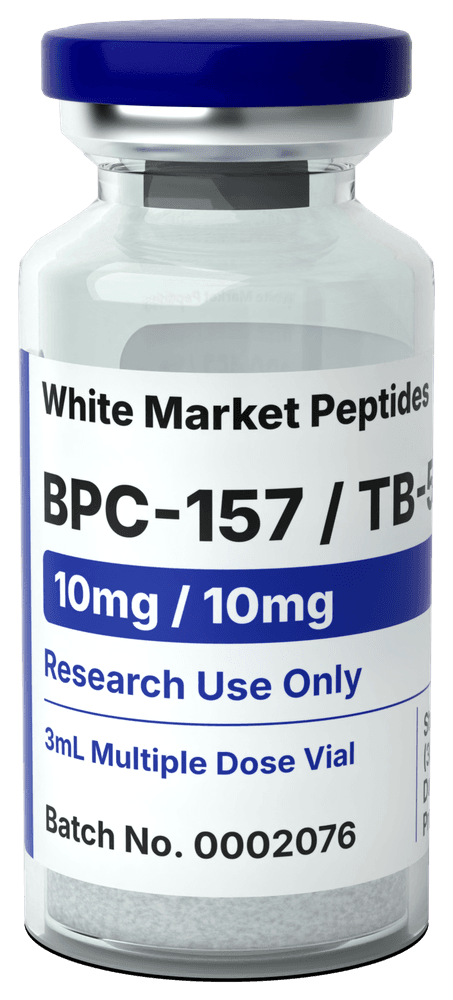
The Wolverine Stack is a pre-mixed 20 mg vial containing BPC-157 (10 mg) + TB-500 (10 mg) in a 1:1 ratio — the most widely used research peptide combination for musculoskeletal recovery. BPC-157 drives local repair; TB-500 provides systemic healing support. Together they address all three phases of tissue healing.[1][2]
- Reconstitute: Add 3.0 mL bacteriostatic water → 6.67 mg/mL total blend (3.33 mg/mL each component).
- Standard dose: Titrate once daily from 500 mcg (Weeks 1–2) → 666 mcg (Weeks 3–4) → 1,000 mcg (Weeks 5–8).
- Easy measuring: At 6.67 mg/mL on a U-100 syringe, 1 unit = 0.01 mL ≈ 66.7 mcg total blend.
- Storage: Lyophilised: freeze at −20 °C; reconstituted: refrigerate at 2–8 °C; use within 4 weeks.
Overview
- Composition: BPC-157 10 mg + TB-500 10 mg (1:1 ratio) in a pre-mixed 20 mg lyophilised vial.
- Goal: Comprehensive musculoskeletal tissue repair combining BPC-157's local healing with TB-500's systemic reach.[1][2]
- Schedule: Once-daily SC injection throughout a 4–8 week course, with the daily dose titrated upward over the cycle.
- Reconstitution: 3.0 mL BAC water per 20 mg vial → 6.67 mg/mL.
- Storage: Lyophilised at −20 °C; reconstituted at 2–8 °C; use within 4 weeks.
What You’ll Need
Plan based on a full 8-week once-daily titrated cycle (56 injections, ~44.3 mg total blend consumed).
- Wolverine Stack Vials (20 mg each): Weeks 1–2 (500 mcg × 14 = 7 mg) + Weeks 3–4 (666 mcg × 14 ≈ 9.3 mg) + Weeks 5–8 (1,000 mcg × 28 = 28 mg) ≈ 44.3 mg ÷ 20 mg per vial → 3 vials cover the full 8-week cycle.
- Insulin Syringes (U-100, 0.3 mL / 30-unit preferred): 56 injections → 56 syringes.
- Bacteriostatic Water (10 mL bottles): 3.0 mL per vial × 3 vials = 9 mL → 1 × 10 mL bottle.
- Alcohol Swabs: 2 per injection → 112 swabs per 8-week cycle.
How to Reconstitute
- Allow frozen lyophilised vial to reach room temperature (10–15 minutes).
- Draw 3.0 mL bacteriostatic water with a sterile syringe.
- Inject slowly down the inner vial wall; avoid injecting directly onto the powder cake.
- Gently swirl until fully dissolved — do not shake. Solution should be clear and colourless.
- Label with reconstitution date and both peptide names; refrigerate at 2–8 °C, protected from light. Use within 4 weeks.
Dosing Schedule
| Week | Total Blend Dose | Units (U-100) | Volume | Frequency | Per Peptide |
|---|---|---|---|---|---|
| Weeks 1–2 | 500 mcg | 7.5 units | 0.075 mL | Once daily | ~250 mcg each |
| Weeks 3–4 | 666 mcg | 10 units | 0.10 mL | Once daily | ~333 mcg each |
| Weeks 5–8 | 1,000 mcg | 15 units | 0.15 mL | Once daily | ~500 mcg each |
Start at 500 mcg once daily (7.5 units / 0.075 mL) for the first two weeks to assess tolerance, then step up to 666 mcg (10 units / 0.10 mL) in weeks 3–4 and 1,000 mcg (15 units / 0.15 mL) from week 5 onward. Each dose splits roughly 1:1 between BPC-157 and TB-500. Run a 4–8 week course; if recovery goals warrant a second course, take a 6-week break before cycling again.
Protocol Details
- Weeks 1–2: 500 mcg (7.5 units / 0.075 mL) once daily SC → ~250 mcg BPC-157 + ~250 mcg TB-500.[1]
- Weeks 3–4: 666 mcg (10 units / 0.10 mL) once daily SC → ~333 mcg BPC-157 + ~333 mcg TB-500.
- Weeks 5–8: 1,000 mcg (15 units / 0.15 mL) once daily SC → ~500 mcg BPC-157 + ~500 mcg TB-500.
- Injection site: Near injury site for BPC-157's local effect; abdomen or thigh adequate for TB-500's systemic distribution.
- Duration: Run a 4–8 week course; for a repeat course, allow a 6-week break before cycling again.
Storage
- Lyophilised: Store at −20 °C (−4 °F); protect from moisture and light.
- Reconstituted: Refrigerate at 2–8 °C. Do not freeze. Use within 4 weeks.
- Appearance: Clear, colourless solution. Discard if cloudy or particulate.
How the Wolverine Stack Works
BPC-157 and TB-500 address tissue healing through complementary, non-overlapping mechanisms that together cover all three phases of tissue repair:
- Phase 1 — Inflammatory (Days 1–5): TB-500 down-regulates NF-κB and pro-inflammatory cytokines (IL-6, TNF-α); BPC-157 normalises the NO pathway and reduces prostaglandin E2 — together shortening the inflammatory phase.[2]
- Phase 2 — Proliferative (Days 5–21): BPC-157 activates FAK-paxillin in tendon fibroblasts and endothelial cells; TB-500 enables cell migration via G-actin sequestration. Both drive angiogenesis to restore blood supply to the injured site.[1]
- Phase 3 — Remodelling (Weeks 3+): TB-500 reduces myofibroblast persistence, limiting fibrosis; BPC-157 supports collagen organisation and tendon cell maturation for restoration of mechanical strength.
Good to Know
- The pre-mixed vial ensures consistent 1:1 dosing of both components — no need for individual reconstitution and mixing.
- For acute localised injuries, inject subcutaneously within 2–5 cm of the injury site to maximise BPC-157's local FAK-paxillin effects.
- WADA-prohibited — both BPC-157 and TB-500 are classified as non-approved peptide hormones (Category S2). Athletes subject to anti-doping rules must not use this stack.
- Track pain scores (NRS scale), range of motion, and swelling at weeks 2, 4, and 8.
- The Wolverine Stack can be upgraded to the GLOW or KLOW blend for broader tissue repair and skin/immune support. See KLOW Protocol.
- Musculoskeletal repair: BPC-157 orthopaedic review: 35 preclinical studies + 1 human pilot showing benefit in tendon, muscle, bone, and cartilage repair.[1]
- Systemic reach: TB-500 distributes body-wide after SC injection, supporting healing in multiple tissues simultaneously.[2]
- Gut protection: BPC-157 component provides additional gut mucosal protection — useful for athletes using NSAIDs during recovery.
- Complementary mechanisms: Local (BPC-157) + systemic (TB-500) repair is more comprehensive than either peptide alone.
- WADA status: Both components prohibited in- and out-of-competition. Not suitable for tested athletes.
- For background on the Wolverine Stack's mechanism, evidence, and safety profile, see What Is the Wolverine Stack?.
Tips for Best Results
- Maintain adequate dietary protein (1.2–1.6 g/kg body weight) for tissue synthesis.
- Gentle range-of-motion exercises within pain-free range support capillary ingrowth and fibroblast recruitment.
- Avoid NSAIDs — they blunt prostaglandin-mediated repair signalling that BPC-157 potentiates.
- Adequate sleep (7–9 hours) maximises overnight tissue repair processes.
Injection Tips
- Clean the vial stopper and injection site with separate alcohol swabs; allow both to air-dry fully before proceeding.
- Using a 29–31 gauge insulin syringe (5/16″ to 1/2″ needle), draw the calculated dose precisely.
- Pinch a fold of skin and insert the needle at 45° into subcutaneous fat (90° is acceptable with a short needle into a well-pinched fold).
- Inject slowly over 2–3 seconds; do not aspirate. Withdraw the needle, apply gentle pressure, and do not rub the site.
- Rotate injection sites (abdomen, thighs, upper arms) and dispose of each syringe in a sharps container immediately after use.
Related on pep-dose
- Article
What is BPC-157?
What is BPC-157? Learn about this healing peptide — mechanism of action, tissue repair benefits, dosing guidelines, and safety profile.
- Protocol
BPC-157 (10 mg)
BPC-157 10mg vial dosage protocol. Reconstitution with bacteriostatic water, injection dosing, syringe units, and schedule.
- Protocol
BPC-157 (5 mg)
BPC-157 5mg vial dosage protocol. Reconstitution, injection schedule, syringe measurements, and recommended dosing for healing.
- Article
What Is TB-500?
What is TB-500 (Thymosin Beta-4 Fragment)? Mechanism of action, tissue repair benefits, recommended dosing, and safety considerations.
- Protocol
TB-500 (10 mg)
TB-500 10mg vial dosage protocol. Reconstitution, injection schedule, syringe units, and tissue repair dosing guide.
- Protocol
TB-500 (5 mg)
TB-500 5mg vial dosage protocol. Reconstitution instructions, loading and maintenance dosing, and syringe measurements.
- Blend
GLOW (70 mg)
GLOW 70mg peptide blend dosage protocol. GHK-Cu + TB-500 + BPC-157 reconstitution, injection schedule, and syringe guide.
- Blend
KLOW (80 mg)
KLOW 80mg peptide blend dosage protocol. GHK-Cu + TB-500 + BPC-157 + KPV reconstitution, escalating 8–12 week dosing schedule, and syringe guide.